


Chamaerops is a genus of flowering plants in the family Arecaceae (palm family), comprising a single species Chamaerops humilis (European fan palm, Mediterranean dwarf palm or dwarf fan palm), is the only palm species native to continental Europe. It is mainly found in southwestern Europe (Spain, Portugal, France, Italy and Malta) and northwest Africa (Morocco, Algeria, Tunisia).
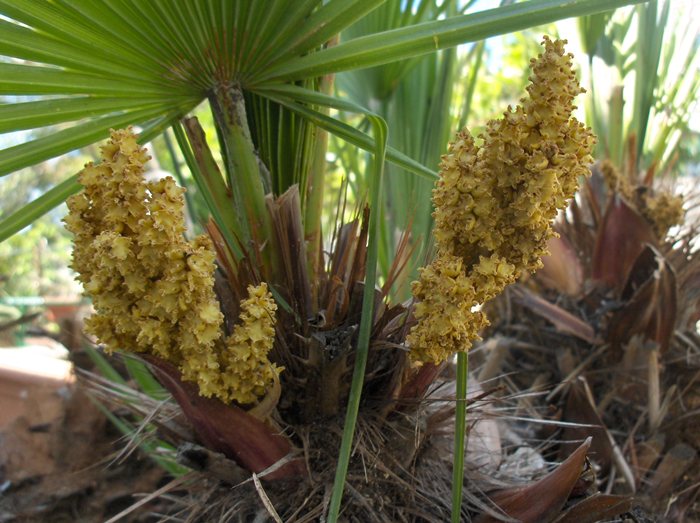
It is a shrub-like clumping palm, with several stems growing from a single base. The stems grow slowly and often tightly together, eventually reaching 2–5 m tall with a trunk diameter of 20–25 cm. The flowers are borne in dense, short inflorescences at the top of the stems; it is usually (but not invariably) dioecious with male and female flowers on separate plants. Unripe fruits are bright green, turning to dull yellow to brown when ripe during the fall (September–November). The seed (usually 0.6–0.8 g) comprises a small cylindrical embryo, which is surrounded by several layers.
C. humilis is used massively in gardening and landscaping in many parts of the world. In temperate regions it is usually cultivated as a houseplant, though in sheltered areas it will survive short periods below freezing point. It is adapted to a Mediterranean climate with cool, moist winters and summer drought, and can grow on poor and rocky soils. It is one of the hardier palms, tolerating winter frosts down to about -12°C. It will grow even in climates where the summer temperature is in the low 20 C.
The ripe pulp of C. humilis has several intriguing ecological functions. First, when ripened, the pulp smells strongly of rancid butter and thus acts as a foraging cue for nocturnal frugivores. Second, it has a germination inhibitory function, ensuring that the seed does not germinate until has been dispersed. And third, the pulp also acts as a chemical and/or physical barrier against invertebrate seed predators (curculionoid beetles). Because of such pulp multifunctionality, fruit ingestion (and thus pulp removal) by carnivores can have both positive and negative consequences for the palm. On the one hand, seeds ingested by carnivores germinate more frequently than non-ingested seeds. On the other hand, ingested seeds experience higher predation by invertebrates than non-ingested seeds. However, because of the high mobility of carnivores, their dispersal service appears paramount given the severe fragmentation and isolation of most C. humilis populations across the highly humanized Mediterranean basin.
Due to its rusticity and resprouting ability after fire, it has a high ecological value for preventing erosion and desertization. This charismatic palm is thus considered one of the most important species in the natural conformation of the "garrigues" and "macchias" of the Mediterranean coastline.
The leaves of the adult plants have been used in basketweaving to make mats, carrier baskets, and brooms. The young unopened leaves are treated with sulphur to make them softer and supple and are then used for finer work. The husk, known in southern Spain as "higa", is edible before its full development. The fruits are not edible but have been traditionally used in medicine as an astringent because of their bitterness and high tannin content.

- You are here:
-
Home

-
Shop
-
Ukrasni grmovi i stabla
- Chamaerops humilis
Products Categories
Your Cart
No items in cart
Currency
Taxi Booking

Chamaerops humilis
 Mediterranean palm
Offer:
10 seeds
Image Gallery




View the embedded image gallery online at:
https://mediteranka.com/index.php/en/katalog/ukrasni-grmovi-i-stabla/item/53-chamaerops-humilis#sigProIdd5475987d8
https://mediteranka.com/index.php/en/katalog/ukrasni-grmovi-i-stabla/item/53-chamaerops-humilis#sigProIdd5475987d8