
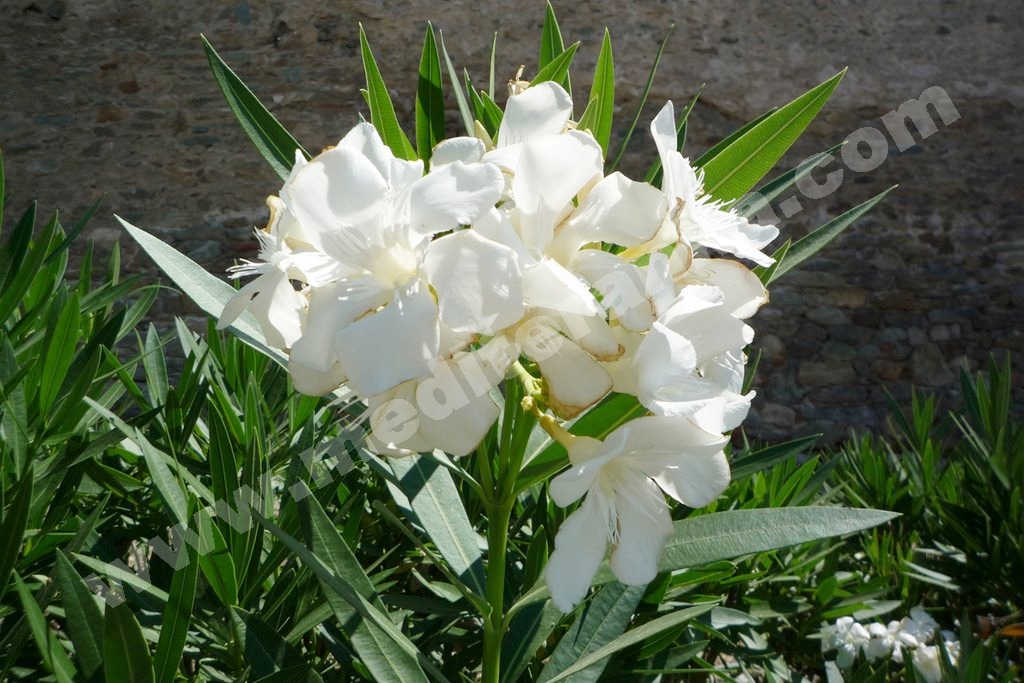
Nerium oleander is an evergreen shrub or small tree in the family Apocynaceae, toxic in all its parts. It is the only species currently classified in the genus Nerium. It is most commonly known as oleander, from its superficial resemblance to the unrelated olive Olea. Oleander is one of the most poisonous of commonly grown garden plants. Oleander grows to 2–6 m tall, the leaves are dark-green, narrow lanceolate, 5–21 cm long. The flowers grow in clusters at the end of each branch, they are white, pink to red, 2.5–5 cm diameter. The fruit is a long narrow capsule 5–23 cm long, which splits open at maturity to release numerous downy seeds. Oleander grows well in warm subtropical regions, where it is extensively used as an ornamental plant in landscapes, in parks, and along roadsides. It is drought-tolerant and will tolerate occasional light frost down to -10 °C. Oleander can also be grown in cooler climates in greenhouses and conservatories, or as indoor plants that can be kept outside in the summer.
Oleander
 oleander
Offer:
100 seeds
Image Gallery


View the embedded image gallery online at:
https://mediteranka.com/index.php/en/katalog/ukrasni-grmovi-i-stabla/item/193-oleander?print=1&tmpl=component#sigProId0639f3e0ad
https://mediteranka.com/index.php/en/katalog/ukrasni-grmovi-i-stabla/item/193-oleander?print=1&tmpl=component#sigProId0639f3e0ad